
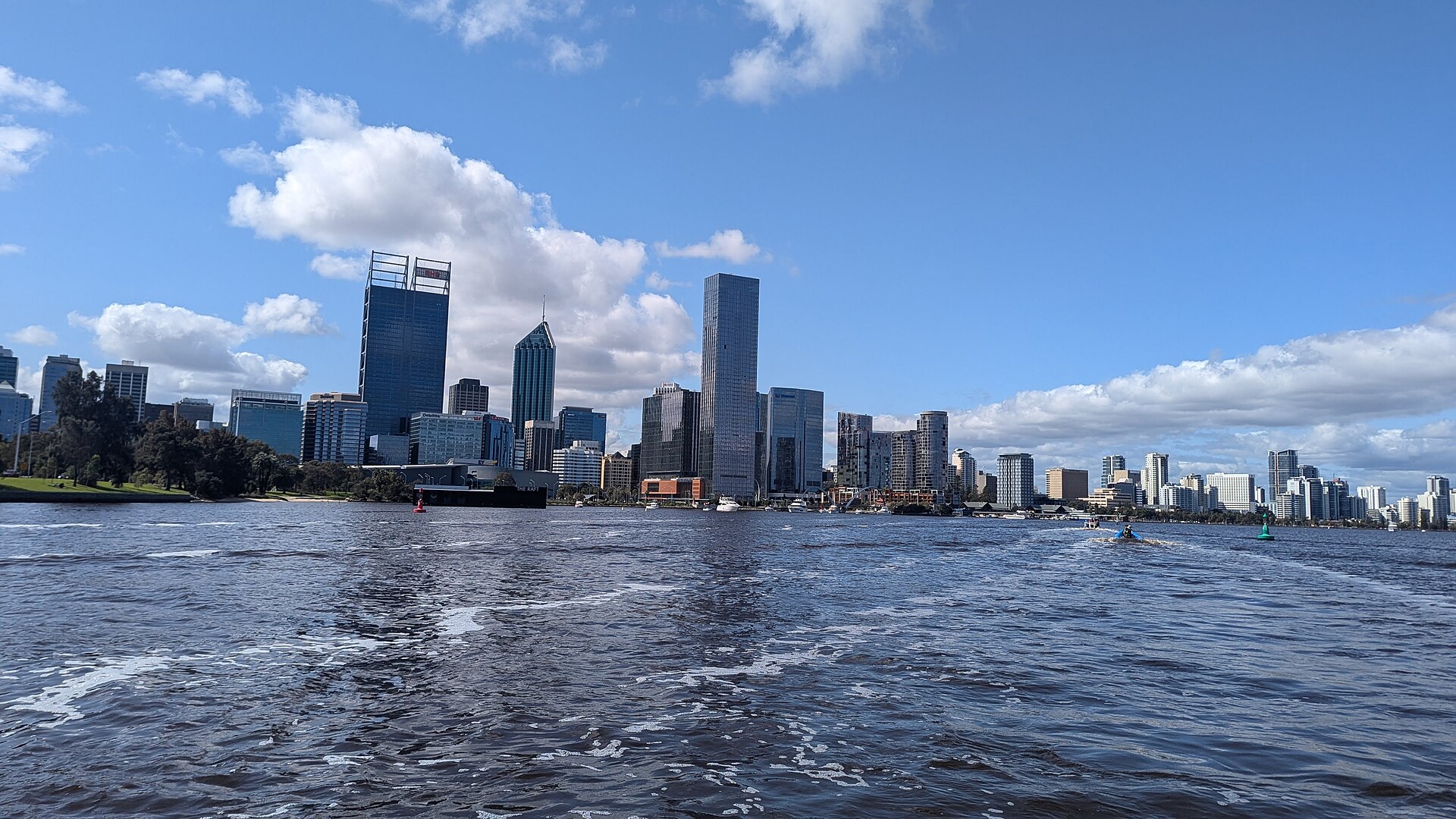
Photo: JamesBromberger, CC BY 4.0, via Wikimedia Commons
Western Australia State Nominated Migration Program: Eligibility and Visa Guide
WA reports 2,327 State nomination invitations in 2026–27 so far. Streams, eligibility, ranking, occupation list and fees.
WA nominates for subclass 190 and 491 through its General and Graduate streams. The 190 in the General stream needs a full-time WA employment contract (building and construction occupations are exempt); the 491 and the Graduate stream do not. WA ranks EOIs by where you live first, so people living in WA come before everyone else, then by sector, points and submission date. It has published no 2026–27 allocation or cut-off scores.
- WA reports 2,327 invitations so far in 2026–27 (1,100 in September, 1,227 in October), but has published no 2026–27 nomination allocation on the page reviewed.
- WA lists three streams: General (WASMOL Schedules 1 and 2), Graduate and a defence industry stream. The defence stream’s requirements are not set out on the page.
- WA ranks EOIs by where you live (WA first), then occupation sector, then points, then submission date.
- The 190 General stream needs a full-time WA employment contract (building and construction occupations are exempt); the 491 and the Graduate stream do not.
- A last-invited EOI score is a single data point, not a cut-off. WA says it ignores occupation and visa caps.
- The 190 adds 5 nomination points and the 491 adds 15; the pathway checker on this page shows how that changes your EOI total and which requirements you meet.
Western Australia (WA) nominates skilled workers for two visas: the Skilled Nominated visa (subclass 190) and the Skilled Work Regional (Provisional) visa (subclass 491). You cannot apply to WA directly. You lodge a SkillSelect Expression of Interest (EOI), WA ranks the EOIs it has received, and it invites the people it selects to apply for nomination. Nomination then lets Home Affairs invite you to apply for the visa itself.
This guide covers the General and Graduate streams, who can be considered, how WA ranks EOIs, what the October 2026 round looked like, the documents WA asks for, and what is not yet published for 2026–27. Every figure is dated, and each is labelled confirmed, historical or unconfirmed in the status table below.
WA State nomination at a glance, 28 October 2026
What the program is
The State Nominated Migration Program (SNMP) is administered by WA Migration Services. WA sets which occupations it will nominate, how it ranks EOIs, and what evidence applicants must give. It is not the visa decision. Home Affairs makes that decision under federal law.
Seven stages stand between you and a visa, and passing one does not carry you through the next. The step-by-step list further down covers the same path in nine practical steps, including preparing evidence and what to do after the visa is granted:
| Stage | Who decides | What it means |
|---|---|---|
| 1. Meet the criteria | You | You meet both the Home Affairs requirements for the visa and WA’s criteria for your stream |
| 2. Lodge an EOI in SkillSelect | You | Your claims are on record with Home Affairs; WA can see your EOI |
| 3. Invitation to apply for State nomination | WA Migration Services | Your EOI ranked high enough in that round |
| 4. Apply for State nomination | You, within 28 calendar days | You lodge the application, the evidence and the $200 fee |
| 5. State nomination | WA Migration Services | WA approves your application and nominates you in SkillSelect, subject to places in the program year |
| 6. Invitation to apply for the visa | Home Affairs | Triggered by the nomination; you then have 60 days to lodge |
| 7. Visa decision | Home Affairs | You met every federal requirement; WA’s nomination is not a visa grant |
Subclass 190 or subclass 491
The 491 gives no permanent residence on grant. WA says that if your EOI seeks both visas you will generally be invited for the 491 first, because you generally score more points for it. If you are invited for both in different rounds, only one application can go ahead. Federal rules apply to both: you must not have turned 45 when you are invited, and you need at least 65 points (Migration Regulations 1994; LIN 19/210).
What is confirmed for 2026–27, and what is not
The table reflects what WA’s program page and linked documents showed on 28 October 2026. “Confirmed” means a current WA statement. “Historical” means true for an earlier date or year. “Unconfirmed” means WA has not published it in the sources reviewed.
| Item | Position | Label |
|---|---|---|
| Program year | WA reports invitations for 2026–27 (1 July 2026 to 30 June 2027): 1,100 in September 2026 and 1,227 in October 2026. None are shown for July or August | Confirmed |
| Is WA inviting? | Yes. Priority trade and non-trade occupations were invited on 14 October 2026, and WA says invitations are anticipated each month, with numbers that may vary | Confirmed |
| Nomination allocation for 2026–27 | No allocation figure appears on the page or in the documents reviewed. WA says nominations are subject to places in the program year and are carried over if none are available | Unconfirmed |
| Criteria document | The criteria PDF WA links is titled “2025–26 State Nominated Migration Program process and requirements (updated July 2025)”. The program page itself carries the current stream requirements. No separate 2026–27 criteria document was found | Unconfirmed |
| Occupation lists | 383 occupations across 609 stream listings in the list WA exports, all marked available with a 65-point minimum. WA says the lists may be updated from time to time | Confirmed |
| Defence industry stream | WA mentions a defence stream with occupations on WASMOL Schedule 3. The page sets out no requirements for it, and the occupation export contained no Schedule 3 rows | Unconfirmed |
| Fee and processing | $200 non-refundable; 28 working days for ‘decision ready’ applications | Confirmed |
| Earlier years | WA’s table shows 11,562 invitations in 2024–25 and 8,162 in 2025–26 | Historical |
WA’s page does not say how many places it holds for 2026–27, so an invitation count is not the same as an allocation. Do not treat 2,327 invitations as a limit or as a measure of how many nominations remain.
Who can be considered
To be invited you must meet both the Home Affairs criteria for the visa and WA’s criteria for your stream. Your EOI must show that:
- you are seeking nomination from Western Australia;
- you are younger than 45;
- you score at least 65 points in the Home Affairs points test;
- you hold a current, valid skills assessment suitable for migration, in the occupation you nominate. A provisional assessment issued for a subclass 485 visa cannot be considered;
- your occupation is available for your visa subclass on the WASMOL (Schedule 1 or 2) for the General stream, or on the Graduate occupation list for the Graduate stream;
- you meet WA’s English requirement; and
- for the Graduate stream, your EOI includes your WA study details and the address and postcode of your WA campus.
WA’s summary table of the three streams:
| Requirement | General · Schedule 1 | General · Schedule 2 | Graduate |
|---|---|---|---|
| Occupation list | WASMOL Schedule 1 | WASMOL Schedule 2 | Graduate occupation list |
| Work experience | At least one year in the nominated or a closely related occupation, in the last 10 years, post-qualification and 20+ hours a week. Australian and overseas experience cannot be combined | Not required | Not required |
| WA employment contract (190 only) | Full-time, at least six months in WA | Full-time, at least six months in WA | Not required |
| WA study | Not required | Not required | A Certificate III or higher from an accredited WA institution, and at least two years of full-time, face-to-face study in WA (WA counts at least 87 weeks) |
| English | Competent English | Competent English | Competent English |
On the program page, closely related means the occupation shares the first four digits of the ANZSCO code. WA’s FAQs, which it says form part of the criteria, also count an occupation that is consistent with a career advancement pathway, or that your assessing authority recognises as closely related. WA does not require a contract for the 491, and says applicants invited through a WA building and construction industry sector occupation do not need one either.
A Schedule 1 or 2 listing is not a job vacancy. WA says occupations on its lists do not relate to specific job vacancies or guarantee a job. A positive skills assessment also does not mean you meet any licensing or registration requirement for the occupation in WA.
Employment contract and work experience rules
- Full-time means an average of at least 35 hours a week. You can combine two contracts to reach 35 hours. Casual contracts do not count.
- Timing. The contract must run for at least six months from the date of your State nomination application. If you have not yet started, the start date must be within three months of lodging, unless you live offshore.
- Contents. Both parties’ full names; permanent or fixed-term full-time; job title, ANZSCO code and duties; location; terms no less favourable than for an Australian citizen or permanent resident; a statement that the work must be performed by the employee, not contracted out; dated signatures from both parties in one document; drafted by the employer.
- Not accepted. Contracts for independent contractors or self-employment. A sole trader’s contract is considered only if the sole trader is not the applicant and the contract meets every other rule. For Schedule 1 occupations, WA says current employment or a contract may include a contracted medical practitioner agreement, a private practice partnership agreement, a locum tenens agreement or a similar employment contract. The page does not explain how that sits with the contractor exclusion.
- Schedule 1 work experience must be in place when you are invited, and counts only if gained after your qualification, in paid employment, at 20+ hours a week. A professional year or work placement does not count unless it meets those rules.
- Graduate stream study. WA measures the two years as at least 87 weeks of completed full-time study, taken from the start and end dates on your completion letters; it can span several qualifications and need not be continuous. More than 25% online study is not eligible, except for COVID-era study between 1 February 2020 and 25 November 2023 while enrolled as an onshore WA student. Credits or recognition of prior learning from outside WA cannot count.
Is your occupation on the list?
WA classifies each occupation into an industry sector and a stream list, and marks which listed occupations are priority occupations. Of the 609 stream listings, 522 are open to subclass 190 and all 609 are open to subclass 491. 223 of the 383 occupations are listed in more than one stream, so check the list for the stream you are actually eligible for: a listing in one stream is not eligibility in another. The explorer below uses WA’s own export and, where WA published one, the October 2026 last-invited EOI for the occupation.
Search WA’s occupation lists
Filter by occupation, ANZSCO code, stream, industry sector, visa subclass and priority status.
Search the 383 occupations on WA’s State Nominated Migration Program lists. Open one to see its streams, the visa subclasses WA lists it for, whether a WA contract is needed, and the last EOIs WA invited in recent rounds.
Type an occupation or code, or choose a filter.
Source: WA Migration Services, eligible occupations list and the last-invited lists (priority and trade occupations) for December 2025, March 2026 and October 2026, 28 October 2026. Every listed occupation carries a 65-point minimum on WA’s list. The contract line applies WA’s stated rule (a full-time WA contract for the 190 in the General stream, except building and construction) to each listing. Last-invited figures describe one EOI per list, not a minimum score, ignore occupation and visa caps, and do not state the visa subclass; when an occupation is on several lists, the numbers from each list are shown together without labels. Lists may change.
How WA ranks EOIs
WA reviews the EOIs submitted through SkillSelect and invites eligible applicants. It ranks them in this order (WA program page):
- Where you live. EOIs from people currently living in WA come first. People living offshore or in another state or territory come second.
- Occupation sector. Priority sectors rank ahead of other sectors: building and construction, healthcare and social assistance, hospitality and tourism, and education and training. WA’s FAQ puts building and construction trades first and the other priority sectors together after them; its October PDFs list the priority sectors “in no particular order”.
- EOI points. Higher scores first.
- EOI submission date. Earlier first, where everything above is equal.
The same order as a flow:
- 11stResidence
Where you live
WA residents first. Offshore applicants and applicants in another state or territory come second, in one group: WA does not rank interstate ahead of offshore.
- 22nd
Occupation sector
Priority sectors ahead of the rest: building and construction, healthcare and social assistance, hospitality and tourism, education and training.
- 33rd
EOI points
Higher points first. Graduate stream: your highest WA qualification is ranked before points.
- 44thTie-break
Submission date
Earlier EOIs first where everything above is equal.
The Graduate stream also ranks by the highest qualification you gained in WA: PhD or master’s, then honours or another higher degree, then bachelor’s for higher education graduates; and Advanced Diploma, Diploma, then Certificate III or IV for VET graduates. WA says up to 75% of Graduate stream nominations will go to higher education graduates and up to 25% to VET graduates.
- If your EOI ranks in several streams you may receive an invitation for each, but you can lodge only one application.
- You will not receive more than one invitation through the same EOI. If an invitation lapses, is withdrawn or declined, you need a new EOI.
- WA’s criteria say invitations are also subject to occupation ceilings and, for the Graduate stream, nomination ceilings for higher education and VET graduates, so rank and points alone do not decide an invitation.
- WA gives no feedback on EOIs that were not invited.
- If you are invited to apply for a subclass 189 visa while your State nomination is pending, Home Affairs locks your EOI, and you must choose between the two.
Invitations by round
WA publishes invitation counts by month, stream and visa for three program years. Use the chart to compare months; every monthly total is in the table under it, and the 190/491 split appears when you hover over or tap a month. These are invitations to apply, not nominations, and WA publishes no nomination allocation, so the counts cannot show how much of a quota has been used.
Invitations by month and stream
Invitations WA reports for each month, split by stream. These are invitations to apply, not nominations and not a quota.
| Month | Sch 1 | Sch 2 | Grad HE | Grad VET | Total |
|---|---|---|---|---|---|
| Sep | 165 | 770 | 124 | 41 | 1,100 |
| Oct | 118 | 948 | 112 | 49 | 1,227 |
| Year | to date (July to October 2026) | 2,327 | |||
Source: WA Migration Services program page, invitation tables for 2024-25, 2025-26 and 2026-27, 28 October 2026. Months with no bar show no invitations in WA’s table. WA publishes no nomination allocation, so these figures cannot show how much of a quota has been used.
September 2026 against October 2026. WA’s page shows these invitation counts for the two 2026–27 rounds so far:
| Stream | Sept 190 | Sept 491 | Oct 190 | Oct 491 |
|---|---|---|---|---|
| General · Schedule 1 | 118 | 47 | 118 | 0 |
| General · Schedule 2 | 549 | 221 | 586 | 362 |
| Graduate · higher education | 88 | 36 | 99 | 13 |
| Graduate · VET | 29 | 12 | 33 | 16 |
| Total | 1,100 (all streams) | 1,227 (all streams) |
Two changes stand out in our reading of the table: Schedule 1 subclass 491 invitations went from 47 to 0, and Schedule 2 subclass 491 invitations rose from 221 to 362. WA does not say why. It does not publish minimum scores or cut-offs for either round. The last-invited-by-occupation lists it does publish are single EOIs, and its page currently carries only the October 2026 lists, so a September-to-October comparison of last-invited points by occupation is not possible. WA has published earlier lists for December 2025 and March 2026 (priority occupations; trade occupations), and the occupation explorer above shows an occupation’s last-invited points across those rounds and October 2026. Each number there comes from a different stream or residence list, so a spread of numbers is not a range to aim for.
The October 2026 round
WA reported invitations on 14 October 2026 for priority trade and non-trade occupations: 1,227 invitations in total, split by stream and visa in the September and October table above. WA also publishes the last EOI invited in each occupation once ranking was complete. Examples from its October 2026 priority occupations and trade occupations lists, as printed:
| Occupation | List | Lived in | EOI points | EOI submitted |
|---|---|---|---|---|
| Registered Nurses nec (254499) | Priority list · Sch 1 | WA | 85 | 07/03/2026 |
| Civil Engineer (233211) | Priority list · Sch 2 | WA | 90 | 30/03/2026 |
| Cook (351411) | Priority list · Sch 2 | WA | 90 | 09/04/2026 |
| Secondary School Teacher (241411) | Priority list · Sch 2 | WA | 90 | 30/03/2026 |
| Electrician (General) (341111) | Trades list | Overseas | 65 | 01/10/2026 |
| Carpenter (331212) | Trades list | Overseas | 65 | 22/09/2026 |
| Plumber (General) (334111) | Trades list | Overseas | 65 | 23/09/2026 |
| Bricklayer (331111) | Trades list | Overseas | 65 | 24/09/2026 |
These are single EOIs, not minimum scores. WA states that the information does not take into account any occupation or visa subclass caps, and the lists do not say which visa subclass each EOI was for. Your EOI’s score also differs by visa, because nomination adds 5 points for the 190 and 15 for the 491. Read the examples as snapshots of who was reached, not as a threshold to aim for.
Across WA’s October 2026 trades list, 21 of the 26 entries are overseas EOIs and 10 of those had 65 points. In the priority occupations list, all 66 last-invited EOIs lived in WA, and all but 3 had 85 to 95 points (the three exceptions are Primary School Teacher entries, at 65, 65 and 70). These are our observations from the lists, and WA does not explain them.
Check your pathway
This checker applies WA’s published requirements to your answers. It adds the nomination points (5 for the 190, 15 for the 491) to the points you enter, tests the General-stream contract and work-experience rules and the Graduate-stream study rule (87 weeks), and shows where your EOI sits in WA’s ranking. Enter your Home Affairs points before nomination points.
WA pathway and points checker
Answer for your stream and visa to see which of WA’s published requirements you meet, how the nomination points change your EOI total, and how WA ranks EOIs. An illustration of WA’s criteria, not an assessment.
+5 nomination points. Permanent. Needs a WA contract unless building and construction.
+15 nomination points. 5-year provisional visa. No WA contract needed.
- ✓ Under 45 when invitedFederal rule for both visas.
- ✓ At least 65 points including nomination points60 + 5 = 65 for the 190.
- ✓ Valid skills assessment for migration purposesA provisional 485 assessment cannot be considered.
- ✓ Competent English (or an eligible passport)Valid on the day you lodge.
- ✕ WA employment contractFull-time (35 hours a week on average), at least six months, in WA. Building and construction occupations are exempt.
- ✕ At least one year of work experienceNominated or closely related occupation, in the last 10 years, 20+ hours a week, after your qualification.
Based on WA’s published criteria as at 28 October 2026. Your Home Affairs points come from the federal points test, and every claim must be provable at invitation. Employment contract questions can be complex, and WA assesses the contract itself.
How to apply, step by step
- 1Step 1
Check your occupation and stream
Confirm your occupation is on the list for your visa subclass and stream, and that your skills assessment matches the occupation you nominate.
- 2Step 2
Lodge your SkillSelect EOI
State that you seek WA nomination; show under 45, 65+ points, your assessment and English. Your points claims must be provable at invitation.
- 3Step 3
Prepare your evidence
Documents must be current and valid on the day you lodge. WA contacts employers and institutions directly to verify them.
- 4Step 4Monthly rounds
Receive an invitation
Rounds are anticipated monthly. An invitation does not guarantee nomination.
- 5Step 528 days
Lodge your State nomination application
Create a Migration WA portal profile, accept the terms and pay $200. You have 28 calendar days.
- 6Step 6~28 working days
WA assesses your application
Current processing time for ‘decision ready’ applications is 28 working days. Outcome by email; a review can be requested within 14 calendar days.
- 7Step 7
WA nominates you in SkillSelect
Subject to places in the program year. If none are available, your application is carried over to the next program year.
- 8Step 860 days
Lodge your visa application
Home Affairs invites you after nomination. You have 60 days to complete the visa application.
- 9Step 9
After the visa is granted
Move to WA within three months if you are not already there, register your arrival or grant date, live and work in WA for two years, and complete WA’s surveys on request.
By lodging an application you agree to work, live and settle in WA. WA nominates an applicant only once in each program year (1 July to 30 June), and invites only once per EOI. Applications are assessed on the evidence supplied at lodgement, and false or misleading information can lead to a decline.
Documents WA may ask for
Common categories, by situation
0/6 doneWA may ask for more information after you lodge, and its checklist for your stream takes precedence over this summary.
English requirement
WA requires at least competent English, with the minimum score in all four components of one approved test. For tests taken on or after 7 August 2025 the minimums are:
| Test | Listening | Reading | Writing | Speaking |
|---|---|---|---|---|
| IELTS Academic or General Training (incl. One Skill Retake) | 6 | 6 | 6 | 6 |
| PTE Academic | 47 | 48 | 51 | 54 |
| TOEFL iBT | 16 | 16 | 19 | 19 |
| Occupational English Test | 290 | 310 | 290 | 330 |
| Cambridge C1 Advanced | 163 | 163 | 170 | 179 |
| CELPIP General | 7 | 7 | 7 | 7 |
| LANGUAGECERT Academic | 57 | 60 | 64 | 70 |
| Michigan English Test (incl. Single Section Retake) | 56 | 55 | 57 | 48 |
Results from approved tests taken on or before 6 August 2025 can be used within their three-year validity until 6 August 2028, at the older score bands listed on WA’s page. Your result must be valid on the day you lodge your State nomination application. British National (Overseas) passports are not acceptable as evidence of competent English.
Costs and timing
WA charges a non-refundable $200 application fee when you lodge. It is separate from the Home Affairs visa application charge (see Home Affairs’ Visa Pricing Estimator), skills assessment fees, English test fees and health or police checks, none of which WA sets. WA’s 28 working days applies to ‘decision ready’ applications: if WA asks for more information, your application is not decision ready until you provide it. Home Affairs’ processing time is separate.
Common mistakes
Defence industry stream
WA’s page lists a third stream, the defence industry stream, whose eligible occupations it says are on WASMOL Schedule 3. That is all the page and its linked documents say. It sets out no eligibility requirements, no occupation list and no ranking rules for the stream, WA’s occupation search returns no occupations when filtered to the defence stream, the occupation list WA exports contains no Schedule 3 rows, and the 2025–26 criteria document covers only the General and Graduate streams. The invitation tables on the page show no defence stream line either.
Until WA publishes them, anything said about which occupations qualify or what the stream requires would be a guess. The sign-up below is for readers who want an email when we update this guide after WA publishes the stream’s details.
WA has not published the defence industry stream’s requirements or occupations. Leave your details and we aim to email you when we update this guide after WA publishes them.
Get the next round’s results
WA says invitations are anticipated each month. Leave your details and we aim to email you when we update this guide with the next round’s results.
Employment contract and work-experience evidence are where WA applications most often turn on detail. Book a 30-minute consultation by phone, Zoom or in person to go through your contract, your EOI claims and your stream before you lodge.
Related guides and next steps
- Subclass 190 visa requirements, from eligibility to grant
- How to score 65 points for subclasses 189, 190 and 491
- 189 vs 190 vs 491: which skilled visa is right for you?
- Canberra Matrix invitation round: latest results, for comparison with another territory
- South Australia’s 2026–27 skilled migration update
- Victoria’s 2026–27 skilled nomination program
Want your occupation, stream and EOI claims reviewed before you lodge? Book a consultation or contact our migration team.
This is general information, not personal migration advice. WA’s occupation lists, criteria, invitation rounds and fees can change, and WA reserves the right to amend them at any time; the figures above are as at 28 October 2026. Global Migrations is the trading name of Global Migration & Education Solutions (ABN 22 998 014 414); our registered migration agent is Ranbir Singh, MARN 1069570. We are not part of the Government of Western Australia.
Wondering how this applies to your situation?
Get an honest, no-obligation read on your pathway from a MARA-registered agent.
People also ask
What is the Western Australia State Nominated Migration Program?
It is WA’s pathway for nominating skilled migrants to apply for a subclass 190 or subclass 491 visa. Migration Services WA ranks SkillSelect EOIs, invites selected applicants to apply for nomination, and, if it approves the application, nominates them in SkillSelect. Home Affairs then decides the visa.
What is the difference between subclass 190 and subclass 491?
The 190 is a permanent visa; the 491 is a temporary 5-year provisional visa for living and working in regional Australia. Nomination adds 5 points for the 190 and 15 for the 491. In the General stream the 190 needs a full-time WA employment contract (building and construction occupations are exempt), and the 491 does not. WA’s 2025–26 criteria document says Perth and surrounding areas are considered regional for the 491.
Can offshore applicants be eligible?
Yes. The General stream does not require you to live in WA, although EOIs from people living in WA are ranked first. Offshore applicants for the 190 in the General stream need a WA employment contract unless their occupation is in building and construction, and the contract’s start date is not subject to the three-month rule if they live offshore. The Graduate stream needs two years of study in WA.
Do I need a job offer?
For the subclass 190 in the General stream, you need a full-time WA employment contract of at least six months in your nominated or a closely related occupation, unless you were invited through a building and construction industry sector occupation. A contract is not required for the 491 or in the Graduate stream.
How do I check whether my occupation is eligible?
Look for your occupation on the WASMOL Schedule 1 or 2 list (General stream) or the Graduate occupation list, and check that it is available for your visa subclass. The occupation explorer on this page uses WA’s own export as at 28 October 2026, and WA may update its lists.
Do I need a skills assessment?
Yes. You need a current, valid skills assessment suitable for migration, in the occupation you nominate. It must be valid when you lodge your State nomination application, and a provisional assessment issued for a subclass 485 visa cannot be considered.
Does meeting the requirements guarantee an invitation?
No. WA says not all EOIs that meet the requirements will receive an invitation. EOIs are ranked by where you live, occupation sector, points and submission date, and WA does not give feedback on EOIs that were not invited.
Is WA inviting applicants for 2026–27?
WA reports 1,100 invitations in September 2026 and 1,227 in October 2026, including a round on 14 October 2026, and says invitations are anticipated each month. It has not published a 2026–27 nomination allocation on the page reviewed, and nominations are subject to places in the program year.
Do I have to live in Western Australia to be invited?
No, but living in WA gives your EOI first priority in ranking. To claim that priority you must show at least three months’ continuous WA residence immediately before the invitation, and still live there when you lodge.
How much does WA nomination cost, and how long does it take?
WA charges a non-refundable $200 application fee. Its current processing time for ‘decision ready’ applications is 28 working days. Home Affairs’ visa charges, skills assessment and English test fees are separate.
Can I be nominated more than once?
WA nominates an applicant only once in each program year (1 July to 30 June) and issues one invitation per EOI. If an invitation lapses or is declined, you need a new EOI. WA may re-invite or re-nominate in exceptional circumstances.
Does WA publish minimum scores or cut-offs?
WA publishes no round-by-round cut-off. Its only stated minimum is the 65-point entry minimum. For each round it publishes the last EOI invited in each occupation (state of residence, points and submission date), and says the information does not take into account occupation or visa subclass caps, so one EOI’s points are not a threshold.
Is there a defence industry stream?
WA’s page lists a defence industry stream with eligible occupations on WASMOL Schedule 3, but it does not publish the stream’s requirements or occupations on the page, and the occupation list it exports has no Schedule 3 rows.
Does WA nomination guarantee a visa?
No. WA states that State nomination does not guarantee your visa application will be granted. Home Affairs assesses the visa against its own requirements.